For businesses that quote, deliver and invoice
One application, not a suite.
Quotes, tickets, time, invoices and payments on one customer record. Nothing is retyped and nothing is synced, because it was never separate.
For businesses that quote, deliver and invoice
Quotes, tickets, time, invoices and payments on one customer record. Nothing is retyped and nothing is synced, because it was never separate.
Change a phone number on a company and it changes on the engineer's job sheet, on next month's invoice and in the audit log. Other software calls that an integration. Here it is the same row of data being read by another screen.
Queues, statuses you name and give behaviour to, saved replies for the questions you answer every week, and an SLA clock that stops while you wait on the customer rather than punishing you for it.
The week on a drag-and-drop board. The engineer gets the address, the history and the form to fill in, signs the work off on site, and it comes back ready to invoice.
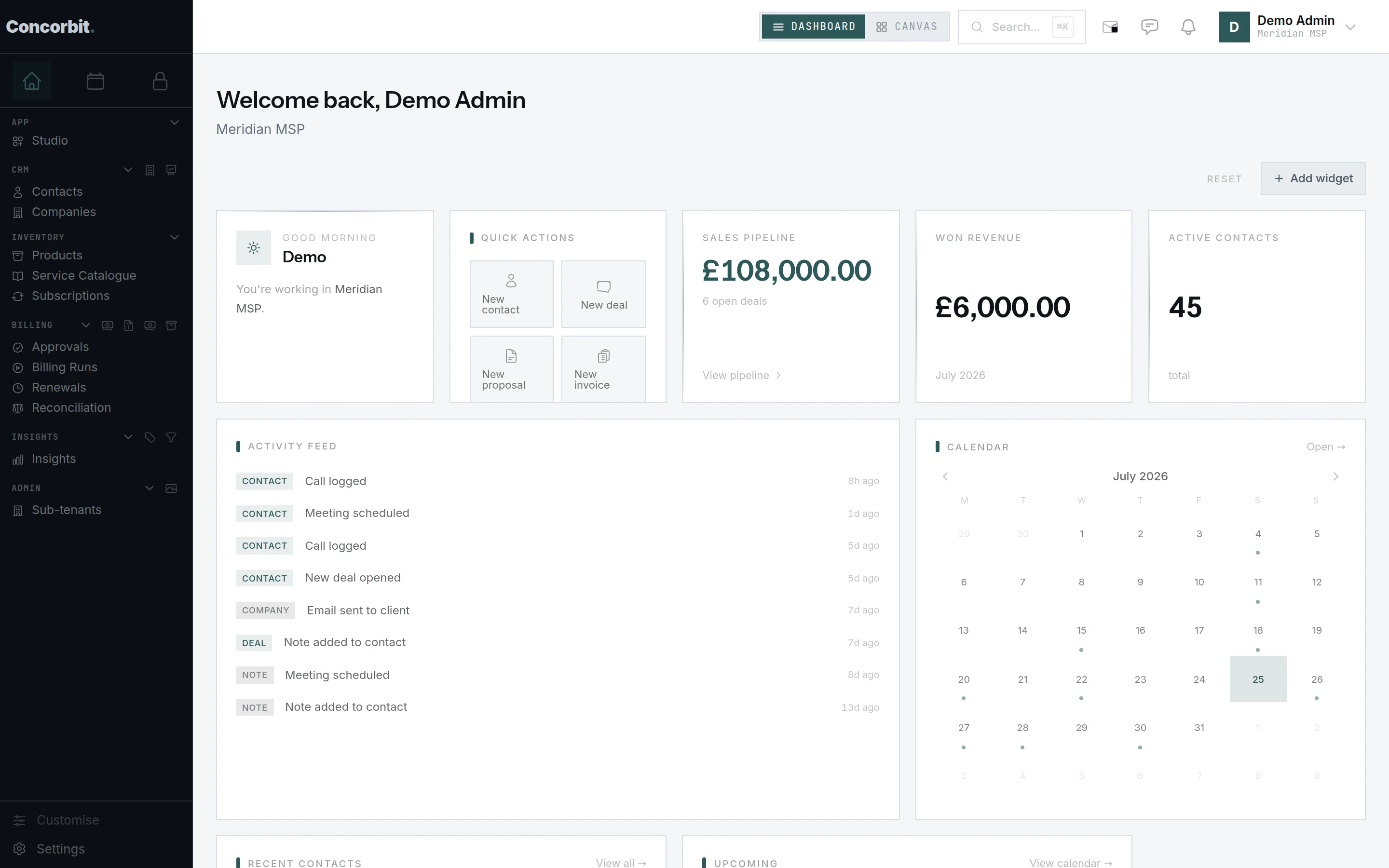
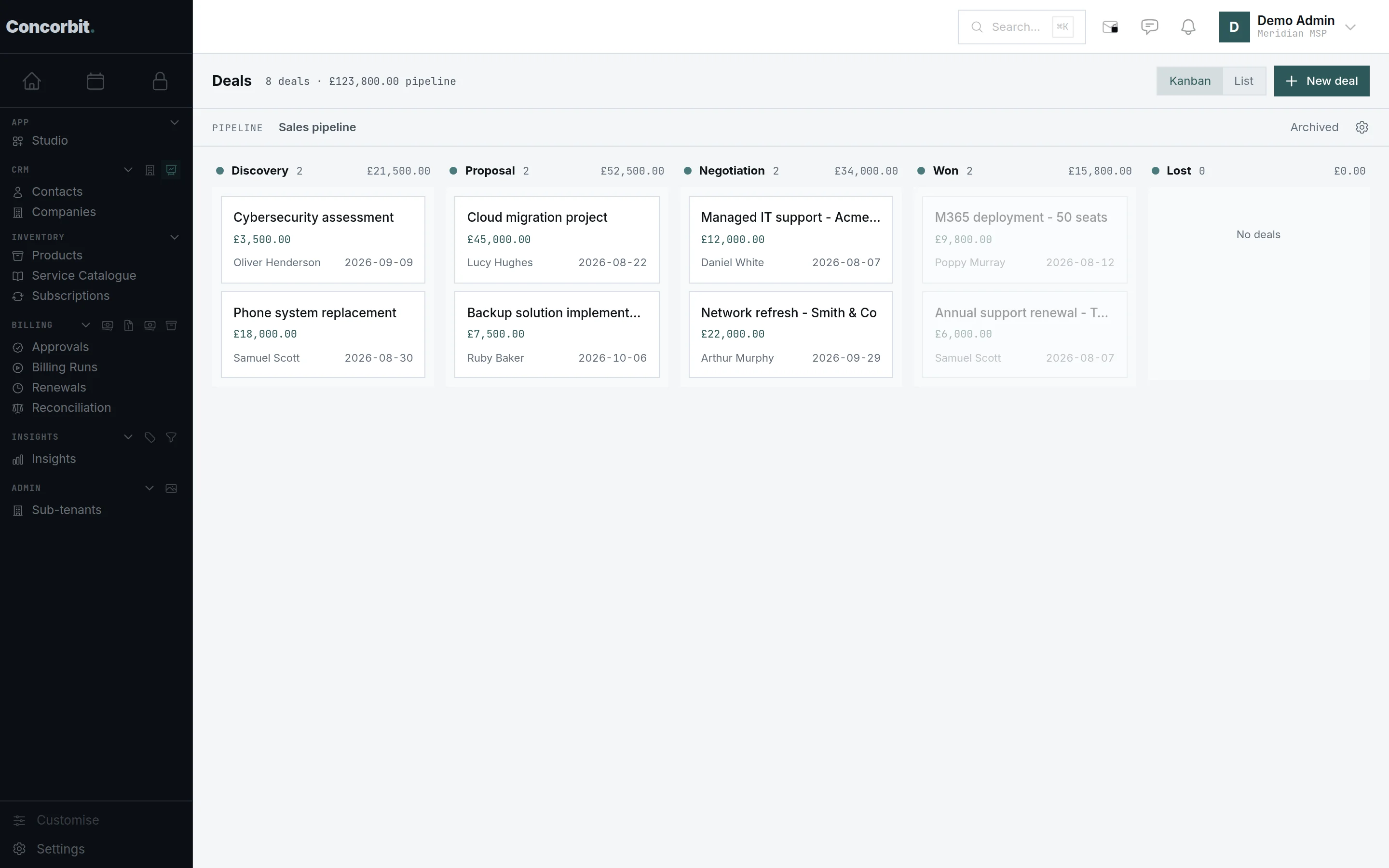
Contacts, companies and deals on the same record as everything else. A proposal goes out, comes back signed in the browser, and files itself against the customer.
Contracts and retainers that warn you before the hours run out, one-off and recurring invoices, card and bank payment through Stripe, and margin reporting from costs that were logged as the work happened.
Customers raise tickets, approve quotes and pay invoices on your own domain. Credentials live against the customer they belong to, not in a spreadsheet.
One date range across the helpdesk, jobs and billing. Click a figure and you are reading the records that produced it, because there is only one place it could have come from.
One record
The reason nothing is retyped and nothing is synced is that there is nowhere else for the data to be. A stack of four tools can only ever copy the disagreement between them on a schedule.
| Concorbit | A typical stack | |
|---|---|---|
| One customer record across every screen | ✓ | ✕ |
| Time logged on site becomes the cost on the invoice | ✓ | re-typed |
| Retainer warns you before the hours run out | ✓ | checked by hand |
| Customer portal on your own domain | ✓ | extra product |
| Statuses you name and give behaviour to | ✓ | ✕ |
| Export your data from settings, on the day you leave | ✓ | support ticket |
| One bill, one login | ✓ | four of each |
Most operations software is a filing problem pretending to be a workflow problem. Concorbit keeps one customer record, so there is nothing to reconcile on a Friday.
Not a marketplace of half-finished connectors. A short list of the systems an operations business actually runs, wired to the one record.
The whole product is one decision, stated four ways.
customer record, not four systems
nightly syncs to break
stages, enquiry to paid
a mobile seat, per month
Electricians, plumbers, HVAC, fire and security, gas. Mobile seats for the people who never open a laptop.
Tickets, time, contracts and billing on one record, replacing Autotask, Halo or ConnectWise at your own pace.
Consultancies, agencies and professional services. Quote, sign, deliver, invoice, get paid, all on the customer.
From £19 per user for the CRM half, £39 with the helpdesk and dispatch, £12 for a mobile seat. No setup fee and no contract.
Early access is invite-only. Drop your email and we'll be in touch when the next intake opens.
One email when we're ready for you, then quiet.